






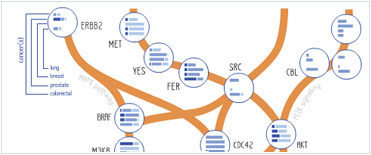






 Foundational characteristics of cancer include proliferation, angiogenesis, migration, evasion of apoptosis, and cellular immortality. Find key markers for these cellular processes and antibodies to detect them.
 The SUMOplot™ Analysis Program predicts and scores sumoylation sites in your protein. SUMOylation is a post-translational modification involved in various cellular processes, such as nuclear-cytosolic transport, transcriptional regulation, apoptosis, protein stability, response to stress, and progression through the cell cycle.
 The Autophagy Receptor Motif Plotter predicts and scores autophagy receptor binding sites in your protein. Identifying proteins connected to this pathway is critical to understanding the role of autophagy in physiological as well as pathological processes such as development, differentiation, neurodegenerative diseases, stress, infection, and cancer.
Goat Anti-ROBO3 / RIG1 (internal) Antibody
Peptide-affinity purified goat antibody

- SPECIFICATION
- CITATIONS
- PROTOCOLS
- BACKGROUND

Application 
| WB, E |
|---|---|
| Primary Accession | Q96MS0 |
| Other Accession | NP_071765, 64221 |
| Reactivity | Human |
| Predicted | Pig, Dog, Cow |
| Host | Goat |
| Clonality | Polyclonal |
| Concentration | 100ug/200ul |
| Isotype | IgG |
| Calculated MW | 148209 Da |
| Gene ID | 64221 |
|---|---|
| Other Names | Roundabout homolog 3, Roundabout-like protein 3, ROBO3 |
| Format | 0.5 mg IgG/ml in Tris saline (20mM Tris pH7.3, 150mM NaCl), 0.02% sodium azide, with 0.5% bovine serum albumin |
| Storage | Maintain refrigerated at 2-8°C for up to 6 months. For long term storage store at -20°C in small aliquots to prevent freeze-thaw cycles. |
| Precautions | Goat Anti-ROBO3 / RIG1 (internal) Antibody is for research use only and not for use in diagnostic or therapeutic procedures. |
| Name | ROBO3 (HGNC:13433) |
|---|---|
| Function | Receptor involved in axon guidance during development (PubMed:15105459). Acts as a multifunctional regulator of pathfinding that simultaneously mediates NELL2 repulsion, inhibits SLIT repulsion, and facilitates Netrin-1/NTN1 attraction. In spinal cord development plays a role in guiding commissural axons probably by preventing premature sensitivity to Slit proteins thus inhibiting Slit signaling through ROBO1/ROBO2. Binding OF NELL2 to the receptor ROBO3 promotes oligomerization of ROBO3, resulting in the repulsion of commissural axons in the midline. ROBO3 also indirectly boosts axon attraction to NTN1 without interacting with NTN1 itself (By similarity). |
| Cellular Location | Membrane {ECO:0000250|UniProtKB:Q9Z2I4}; Single- pass type I membrane protein |

Thousands of laboratories across the world have published research that depended on the performance of antibodies from Abcepta to advance their research. Check out links to articles that cite our products in major peer-reviewed journals, organized by research category.
info@abcepta.com, and receive a free "I Love Antibodies" mug.

Provided below are standard protocols that you may find useful for product applications.
Background
This gene is a member of the Roundabout (ROBO) gene family that controls neurite outgrowth, growth cone guidance, and axon fasciculation. ROBO proteins are a subfamily of the immunoglobulin transmembrane receptor superfamily. SLIT proteins 1-3, a family of secreted chemorepellants, are ligands for ROBO proteins and SLIT/ROBO interactions regulate myogenesis, leukocyte migration, kidney morphogenesis, angiogenesis, and vasculogenesis in addition to neurogenesis. This gene, ROBO3, has a putative extracellular domain with five immunoglobulin (Ig)-like loops and three fibronectin (Fn) type III motifs, a transmembrane segment, and a cytoplasmic tail with three conserved signaling motifs: CC0, CC2, and CC3 (CC for conserved cytoplasmic). Unlike other ROBO family members, ROBO3 lacks motif CC1. The ROBO3 gene regulates axonal navigation at the ventral midline of the neural tube. In mouse, loss of Robo3 results in a complete failure of commissural axons to cross the midline throughout the spinal cord and the hindbrain. Mutations ROBO3 result in horizontal gaze palsy with progressive scoliosis (HGPPS); an autosomal recessive disorder characterized by congenital absence of horizontal gaze, progressive scoliosis, and failure of the corticospinal and somatosensory axon tracts to cross the midline in the medulla. Alternative transcript variants have been described but have not been experimentally validated.
References
Bilateral synergistic convergence associated with homozygous ROB03 mutation (p.Pro771Leu). Khan AO, et al. Ophthalmology, 2008 Dec. PMID 19041479.
Five new consanguineous families with horizontal gaze palsy and progressive scoliosis and novel ROBO3 mutations. Abu-Amero KK, et al. J Neurol Sci, 2009 Jan 15. PMID 18829051.
Genetic analyses of roundabout (ROBO) axon guidance receptors in autism. Anitha A, et al. Am J Med Genet B Neuropsychiatr Genet, 2008 Oct 5. PMID 18270976.
Association study between Gilles de la Tourette Syndrome and two genes in the Robo-Slit pathway located in the chromosome 11q24 linked/associated region. Miranda DM, et al. Am J Med Genet B Neuropsychiatr Genet, 2008 Jan 5. PMID 17671968.
Horizontal gaze palsy with progressive scoliosis can result from compound heterozygous mutations in ROBO3. Chan WM, et al. J Med Genet, 2006 Mar. PMID 16525029.

If you have used an Abcepta product and would like to share how it has performed, please click on the "Submit Review" button and provide the requested information. Our staff will examine and post your review and contact you if needed.
If you have any additional inquiries please email technical services at tech@abcepta.com.

Ordering Information
Other Products
Shipping Information
