






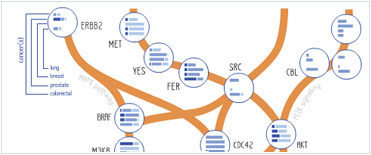








 Foundational characteristics of cancer include proliferation, angiogenesis, migration, evasion of apoptosis, and cellular immortality. Find key markers for these cellular processes and antibodies to detect them.
 The SUMOplot™ Analysis Program predicts and scores sumoylation sites in your protein. SUMOylation is a post-translational modification involved in various cellular processes, such as nuclear-cytosolic transport, transcriptional regulation, apoptosis, protein stability, response to stress, and progression through the cell cycle.
 The Autophagy Receptor Motif Plotter predicts and scores autophagy receptor binding sites in your protein. Identifying proteins connected to this pathway is critical to understanding the role of autophagy in physiological as well as pathological processes such as development, differentiation, neurodegenerative diseases, stress, infection, and cancer.
DDX21 Antibody (N-term)
Affinity Purified Rabbit Polyclonal Antibody (Pab)

- SPECIFICATION
- CITATIONS: 1
- PROTOCOLS
- BACKGROUND

Application 
| WB, E |
|---|---|
| Primary Accession | Q9NR30 |
| Other Accession | NP_004719.2 |
| Reactivity | Human |
| Host | Rabbit |
| Clonality | Polyclonal |
| Isotype | Rabbit IgG |
| Calculated MW | 87344 Da |
| Antigen Region | 128-156 aa |
| Gene ID | 9188 |
|---|---|
| Other Names | Nucleolar RNA helicase 2, DEAD box protein 21, Gu-alpha, Nucleolar RNA helicase Gu, Nucleolar RNA helicase II, RH II/Gu, DDX21 |
| Target/Specificity | This DDX21 antibody is generated from rabbits immunized with a KLH conjugated synthetic peptide between 128-156 amino acids from the N-terminal region of human DDX21. |
| Dilution | WB~~1:2000 |
| Format | Purified polyclonal antibody supplied in PBS with 0.09% (W/V) sodium azide. This antibody is purified through a protein A column, followed by peptide affinity purification. |
| Storage | Maintain refrigerated at 2-8°C for up to 2 weeks. For long term storage store at -20°C in small aliquots to prevent freeze-thaw cycles. |
| Precautions | DDX21 Antibody (N-term) is for research use only and not for use in diagnostic or therapeutic procedures. |
| Name | DDX21 |
|---|---|
| Function | RNA helicase that acts as a sensor of the transcriptional status of both RNA polymerase (Pol) I and II: promotes ribosomal RNA (rRNA) processing and transcription from polymerase II (Pol II) (PubMed:25470060, PubMed:28790157). Binds various RNAs, such as rRNAs, snoRNAs, 7SK and, at lower extent, mRNAs (PubMed:25470060). In the nucleolus, localizes to rDNA locus, where it directly binds rRNAs and snoRNAs, and promotes rRNA transcription, processing and modification. Required for rRNA 2'-O-methylation, possibly by promoting the recruitment of late-acting snoRNAs SNORD56 and SNORD58 with pre- ribosomal complexes (PubMed:25470060, PubMed:25477391). In the nucleoplasm, binds 7SK RNA and is recruited to the promoters of Pol II- transcribed genes: acts by facilitating the release of P-TEFb from inhibitory 7SK snRNP in a manner that is dependent on its helicase activity, thereby promoting transcription of its target genes (PubMed:25470060). Functions as a cofactor for JUN-activated transcription: required for phosphorylation of JUN at 'Ser-77' (PubMed:11823437, PubMed:25260534). Can unwind double-stranded RNA (helicase) and can fold or introduce a secondary structure to a single- stranded RNA (foldase) (PubMed:9461305). Together with SIRT7, required to prevent R-loop-associated DNA damage and transcription-associated genomic instability: deacetylation by SIRT7 activates the helicase activity, thereby overcoming R-loop-mediated stalling of RNA polymerases (PubMed:28790157). Involved in rRNA processing (PubMed:14559904, PubMed:18180292). May bind to specific miRNA hairpins (PubMed:28431233). Component of a multi-helicase-TICAM1 complex that acts as a cytoplasmic sensor of viral double-stranded RNA (dsRNA) and plays a role in the activation of a cascade of antiviral responses including the induction of pro-inflammatory cytokines via the adapter molecule TICAM1 (By similarity). |
| Cellular Location | Nucleus, nucleolus. Nucleus, nucleoplasm. Cytoplasm, cytosol {ECO:0000250|UniProtKB:Q9JIK5}. Mitochondrion {ECO:0000250|UniProtKB:Q9JIK5}. Note=Present both in nucleolus and nucleoplasm. Interaction with JUN promotes translocation from the nucleolus to the nucleoplasm (PubMed:11823437, PubMed:18180292) Interaction with WDR46 is required for localization to the nucleolus (PubMed:23848194). Colocalizes in the cytosol with DDX1, DHX36 and TICAM1. The multi-helicase-TICAM1 complex may translocate to the mitochondria upon poly(I:C) RNA ligand stimulation (By similarity) {ECO:0000250|UniProtKB:Q9JIK5, ECO:0000269|PubMed:11823437, ECO:0000269|PubMed:18180292, ECO:0000269|PubMed:23848194} |

Provided below are standard protocols that you may find useful for product applications.
Background
DEAD box proteins, characterized by the conserved motif Asp-Glu-Ala-Asp (DEAD), are putative RNA helicases. They are implicated in a number of cellular processes involving alteration of RNA secondary structure such as translation initiation, nuclear and mitochondrial splicing, and ribosome and spliceosome assembly. Based on their distribution patterns, some members of this family are believed to be involved in embryogenesis, spermatogenesis, and cellular growth and division. This gene encodes a DEAD box protein, which is an antigen recognized by autoimmune antibodies from a patient with watermelon stomach disease. This protein unwinds double-stranded RNA, folds single-stranded RNA, and may play important roles in ribosomal RNA biogenesis, RNA editing, RNA transport, and general transcription.
References
Holmstrom, T.H., et al. J. Biol. Chem. 283(11):7046-7053(2008)
Sugiyama, N., et al. Mol. Cell Proteomics 6(6):1103-1109(2007)
Ewing, R.M., et al. Mol. Syst. Biol. 3, 89 (2007) :
Olsen, J.V., et al. Cell 127(3):635-648(2006)
Nousiainen, M., et al. Proc. Natl. Acad. Sci. U.S.A. 103(14):5391-5396(2006)

If you have used an Abcepta product and would like to share how it has performed, please click on the "Submit Review" button and provide the requested information. Our staff will examine and post your review and contact you if needed.
If you have any additional inquiries please email technical services at tech@abcepta.com.


Ordering Information
Other Products
Shipping Information
