






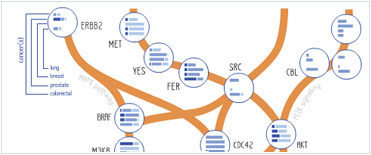








 Foundational characteristics of cancer include proliferation, angiogenesis, migration, evasion of apoptosis, and cellular immortality. Find key markers for these cellular processes and antibodies to detect them.
 The SUMOplot™ Analysis Program predicts and scores sumoylation sites in your protein. SUMOylation is a post-translational modification involved in various cellular processes, such as nuclear-cytosolic transport, transcriptional regulation, apoptosis, protein stability, response to stress, and progression through the cell cycle.
 The Autophagy Receptor Motif Plotter predicts and scores autophagy receptor binding sites in your protein. Identifying proteins connected to this pathway is critical to understanding the role of autophagy in physiological as well as pathological processes such as development, differentiation, neurodegenerative diseases, stress, infection, and cancer.
USP13 Antibody (N-term)
Purified Rabbit Polyclonal Antibody (Pab)
- SPECIFICATION
- CITATIONS
- PROTOCOLS
- BACKGROUND

Application 
| WB, E |
|---|---|
| Primary Accession | Q92995 |
| Other Accession | E1BMF7, NP_003931 |
| Reactivity | Human |
| Predicted | Bovine |
| Host | Rabbit |
| Clonality | Polyclonal |
| Isotype | Rabbit IgG |
| Calculated MW | 97327 Da |
| Antigen Region | 156-186 aa |
| Gene ID | 8975 |
|---|---|
| Other Names | Ubiquitin carboxyl-terminal hydrolase 13, Deubiquitinating enzyme 13, Isopeptidase T-3, ISOT-3, Ubiquitin thioesterase 13, Ubiquitin-specific-processing protease 13, USP13, ISOT3 |
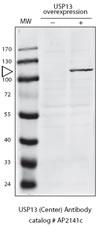
| Target/Specificity | This USP13 antibody is generated from rabbits immunized with a KLH conjugated synthetic peptide between 156-186 amino acids from the N-terminal region of human USP13. |
| Dilution | WB~~1:1000 |
| Format | Purified polyclonal antibody supplied in PBS with 0.09% (W/V) sodium azide. This antibody is prepared by Saturated Ammonium Sulfate (SAS) precipitation followed by dialysis against PBS. |
| Storage | Maintain refrigerated at 2-8°C for up to 2 weeks. For long term storage store at -20°C in small aliquots to prevent freeze-thaw cycles. |
| Precautions | USP13 Antibody (N-term) is for research use only and not for use in diagnostic or therapeutic procedures. |
| Name | USP13 |
|---|---|
| Synonyms | ISOT3 |
| Function | Deubiquitinase that mediates deubiquitination of target proteins such as BECN1, MITF, SKP2 and USP10 and is involved in various processes such as autophagy, endoplasmic reticulum-associated degradation (ERAD), cell cycle progression or DNA damage response (PubMed:21571647, PubMed:32772043, PubMed:33592542). Component of a regulatory loop that controls autophagy and p53/TP53 levels: mediates deubiquitination of BECN1, a key regulator of autophagy, leading to stabilize the PIK3C3/VPS34-containing complexes. Alternatively, forms with NEDD4 a deubiquitination complex, which subsequently stabilizes VPS34 to promote autophagy (PubMed:32101753). Also deubiquitinates USP10, an essential regulator of p53/TP53 stability. In turn, PIK3C3/VPS34-containing complexes regulate USP13 stability, suggesting the existence of a regulatory system by which PIK3C3/VPS34-containing complexes regulate p53/TP53 protein levels via USP10 and USP13. Recruited by nuclear UFD1 and mediates deubiquitination of SKP2, thereby regulating endoplasmic reticulum-associated degradation (ERAD). Also regulates ERAD through the deubiquitination of UBL4A a component of the BAG6/BAT3 complex. Mediates stabilization of SIAH2 independently of deubiquitinase activity: binds ubiquitinated SIAH2 and acts by impairing SIAH2 autoubiquitination. Regulates the cell cycle progression by stabilizing cell cycle proteins such as SKP2 and AURKB (PubMed:32772043). In addition, plays an important role in maintaining genomic stability and in DNA replication checkpoint activation via regulation of RAP80 and TOPBP1 (PubMed:33592542). Deubiquitinates the multifunctional protein HMGB1 and subsequently drives its nucleocytoplasmic localization and its secretion (PubMed:36585612). Positively regulates type I and type II interferon signalings by deubiquitinating STAT1 but negatively regulates antiviral response by deubiquitinating STING1 (PubMed:23940278, PubMed:28534493). |
| Cellular Location | Cytoplasm. |
| Tissue Location | Highly expressed in ovary and testes. |

Thousands of laboratories across the world have published research that depended on the performance of antibodies from Abcepta to advance their research. Check out links to articles that cite our products in major peer-reviewed journals, organized by research category.
info@abcepta.com, and receive a free "I Love Antibodies" mug.

Provided below are standard protocols that you may find useful for product applications.
Background
Modification of target proteins by ubiquitin participates in a wide array of biological functions. Proteins destined for degradation or processing via the 26 S proteasome are coupled to multiple copies of ubiquitin. However, attachment of ubiquitin or ubiquitin-related molecules may also result in changes in subcellular distribution or modification of protein activity. An additional level of ubiquitin regulation, deubiquitination, is catalyzed by proteases called deubiquitinating enzymes, which fall into four distinct families. Ubiquitin C-terminal hydrolases, ubiquitin-specific processing proteases (USPs),1 OTU-domain ubiquitin-aldehyde-binding proteins, and Jab1/Pad1/MPN-domain-containing metallo-enzymes. Among these four families, USPs represent the most widespread and represented deubiquitinating enzymes across evolution. USPs tend to release ubiquitin from a conjugated protein. They display similar catalytic domains containing conserved Cys and His boxes but divergent N-terminal and occasionally C-terminal extensions, which are thought to function in substrate recognition, subcellular localization, and protein-protein interactions.
References
Puente, X.S., et al., Nat. Rev. Genet. 4(7):544-558 (2003).
D'Andrea, A., et al., Crit. Rev. Biochem. Mol. Biol. 33(5):337-352 (1998).
Timms, K.M., et al., Gene 217 (1-2), 101-106 (1998).

If you have used an Abcepta product and would like to share how it has performed, please click on the "Submit Review" button and provide the requested information. Our staff will examine and post your review and contact you if needed.
If you have any additional inquiries please email technical services at tech@abcepta.com.


Ordering Information
Other Products
Shipping Information
