






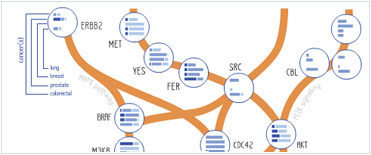








 Foundational characteristics of cancer include proliferation, angiogenesis, migration, evasion of apoptosis, and cellular immortality. Find key markers for these cellular processes and antibodies to detect them.
 The SUMOplot™ Analysis Program predicts and scores sumoylation sites in your protein. SUMOylation is a post-translational modification involved in various cellular processes, such as nuclear-cytosolic transport, transcriptional regulation, apoptosis, protein stability, response to stress, and progression through the cell cycle.
 The Autophagy Receptor Motif Plotter predicts and scores autophagy receptor binding sites in your protein. Identifying proteins connected to this pathway is critical to understanding the role of autophagy in physiological as well as pathological processes such as development, differentiation, neurodegenerative diseases, stress, infection, and cancer.
SUMO1 Antibody (C-term) Blocking Peptide
Synthetic peptide
- SPECIFICATION
- CITATIONS
- PROTOCOLS
- BACKGROUND
| Primary Accession | P63165 |
|---|---|
| Clone Names | 2012302 |
| Gene ID | 7341 |
|---|---|
| Other Names | Small ubiquitin-related modifier 1, SUMO-1, GAP-modifying protein 1, GMP1, SMT3 homolog 3, Sentrin, Ubiquitin-homology domain protein PIC1, Ubiquitin-like protein SMT3C, Smt3C, Ubiquitin-like protein UBL1, SUMO1, SMT3C, SMT3H3, UBL1 |
| Target/Specificity | The synthetic peptide sequence used to generate the antibody AP1222a was selected from the C-term region of human SUMO1. A 10 to 100 fold molar excess to antibody is recommended. Precise conditions should be optimized for a particular assay. |
| Format | Peptides are lyophilized in a solid powder format. Peptides can be reconstituted in solution using the appropriate buffer as needed. |
| Storage | Maintain refrigerated at 2-8°C for up to 6 months. For long term storage store at -20°C. |
| Precautions | This product is for research use only. Not for use in diagnostic or therapeutic procedures. |
| Name | SUMO1 |
|---|---|
| Synonyms | SMT3C, SMT3H3, UBL1 |
| Function | Ubiquitin-like protein that can be covalently attached to proteins as a monomer or a lysine-linked polymer. Covalent attachment via an isopeptide bond to its substrates requires prior activation by the E1 complex SAE1-SAE2 and linkage to the E2 enzyme UBE2I, and can be promoted by E3 ligases such as PIAS1-4, RANBP2 or CBX4. This post- translational modification on lysine residues of proteins plays a crucial role in a number of cellular processes such as nuclear transport, DNA replication and repair, mitosis and signal transduction. Involved for instance in targeting RANGAP1 to the nuclear pore complex protein RANBP2. Covalently attached to the voltage-gated potassium channel KCNB1; this modulates the gating characteristics of KCNB1 (PubMed:19223394). Polymeric SUMO1 chains are also susceptible to polyubiquitination which functions as a signal for proteasomal degradation of modified proteins. May also regulate a network of genes involved in palate development. Covalently attached to ZFHX3 (PubMed:24651376). |
| Cellular Location | Nucleus membrane. Nucleus speckle {ECO:0000250|UniProtKB:P63166}. Cytoplasm. Nucleus, PML body. Cell membrane. Nucleus. Note=Recruited by BCL11A into the nuclear body (By similarity). In the presence of ZFHX3, sequesterd to nuclear body (NB)-like dots in the nucleus some of which overlap or closely associate with PML body (PubMed:24651376) {ECO:0000250|UniProtKB:P63166, ECO:0000269|PubMed:24651376} |

Thousands of laboratories across the world have published research that depended on the performance of antibodies from Abcepta to advance their research. Check out links to articles that cite our products in major peer-reviewed journals, organized by research category.
info@abcepta.com, and receive a free "I Love Antibodies" mug.

Provided below are standard protocols that you may find useful for product applications.
Background
Covalent attachment of one protein to another is one of the more prominent posttranslational modifications in respects to size and ubiquity ? to which eukaryotic proteins are subject. Ubiquitin is the most familiar of the protein modifiers and its activation and transfer to target proteins has been studied for over two decades. Recently a new group of ubiquitin-like (Ubl) proteins have come to light. One of the most intriguing of them is SUMO (small ubiquitin-like modifier, ~12kDa) also known as Sentrin. SUMO family has been described in vertebrates: SUMO-1 and the closest homologs SUMO-2 and SUMO-3. SUMO have been shown to bind and regulate mammalian SP-RINGs (such as Mdm2, PIAS and PML), RanGAP1, RanBP2, p53, p73, HIPK2, TEL, c-Jun, Fas, Daxx, TNFRI, Topo-I, Topo-II, WRN, Sp100, IkB-alpha, Androgen receptor (AR), GLUT1/4, Drosophila Ttk69, Dorsal, CaMK, yeast Septins, and viral CMV-IE1/2, EBV-BZLF1, HPV/BPV-E1. These bindings implicate SUMO in the stabilization of the target proteins and/or their localization to subcellular complexes. SUMO research enters now an exciting phase with a promise to help understanding how cells orchestrate the complexities of rapidly regulating protein level and activity.
References
Yang, S.H., et al., Mol. Cell 13(4):611-617 (2004).Bailey, D., et al., J. Biol. Chem. 279(1):692-703 (2004).Ling, Y., et al., Nucleic Acids Res. 32(2):598-610 (2004).Pountney, D.L., et al., Exp. Neurol. 184(1):436-446 (2003).Ohshima, T., et al., J. Biol. Chem. 278(51):50833-50842 (2003).

If you have used an Abcepta product and would like to share how it has performed, please click on the "Submit Review" button and provide the requested information. Our staff will examine and post your review and contact you if needed.
If you have any additional inquiries please email technical services at tech@abcepta.com.

Ordering Information
Other Products
Shipping Information
