






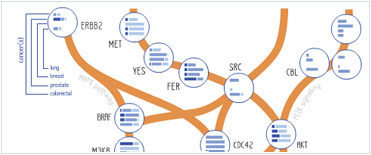








 Foundational characteristics of cancer include proliferation, angiogenesis, migration, evasion of apoptosis, and cellular immortality. Find key markers for these cellular processes and antibodies to detect them.
 The SUMOplot™ Analysis Program predicts and scores sumoylation sites in your protein. SUMOylation is a post-translational modification involved in various cellular processes, such as nuclear-cytosolic transport, transcriptional regulation, apoptosis, protein stability, response to stress, and progression through the cell cycle.
 The Autophagy Receptor Motif Plotter predicts and scores autophagy receptor binding sites in your protein. Identifying proteins connected to this pathway is critical to understanding the role of autophagy in physiological as well as pathological processes such as development, differentiation, neurodegenerative diseases, stress, infection, and cancer.
Phospho-EIF4E(S209) Antibody Blocking peptide
Synthetic peptide
- SPECIFICATION
- CITATIONS
- PROTOCOLS
- BACKGROUND
| Primary Accession | P06730 |
|---|---|
| Clone Names | 110287 |
| Gene ID | 1977 |
|---|---|
| Other Names | Eukaryotic translation initiation factor 4E, eIF-4E, eIF4E, eIF-4F 25 kDa subunit, mRNA cap-binding protein, EIF4E, EIF4EL1, EIF4F |
| Target/Specificity | The synthetic peptide sequence used to generate the antibody AP3474a was selected from the region of human Phospho-EIF4E-S209. A 10 to 100 fold molar excess to antibody is recommended. Precise conditions should be optimized for a particular assay. |
| Format | Peptides are lyophilized in a solid powder format. Peptides can be reconstituted in solution using the appropriate buffer as needed. |
| Storage | Maintain refrigerated at 2-8°C for up to 6 months. For long term storage store at -20°C. |
| Precautions | This product is for research use only. Not for use in diagnostic or therapeutic procedures. |
| Name | EIF4E (HGNC:3287) |
|---|---|
| Synonyms | EIF4EL1, EIF4F |
| Function | Acts in the cytoplasm to initiate and regulate protein synthesis and is required in the nucleus for export of a subset of mRNAs from the nucleus to the cytoplasm which promotes processes such as RNA capping, processing and splicing (PubMed:11606200, PubMed:24335285, PubMed:29987188, PubMed:22684010, PubMed:22578813). Component of the protein complex eIF4F, which is involved in the recognition of the mRNA cap, ATP-dependent unwinding of 5'-terminal secondary structure and recruitment of mRNA to the ribosome (By similarity). This protein recognizes and binds the 7-methylguanosine (m7G)-containing mRNA cap during an early step in the initiation of protein synthesis and facilitates ribosome binding by inducing the unwinding of the mRNAs secondary structures (PubMed:16271312, PubMed:22578813). Together with EIF4G1, antagonizes the scanning promoted by EIF1-EIF4G1 and is required for TISU translation, a process where the TISU element recognition makes scanning unnecessary (PubMed:29987188). In addition to its role in translation initiation, also acts as a regulator of translation and stability in the cytoplasm (PubMed:24335285). Component of the CYFIP1-EIF4E-FMR1 complex which binds to the mRNA cap and mediates translational repression: in the complex, EIF4E mediates the binding to the mRNA cap (By similarity). Component of a multiprotein complex that sequesters and represses translation of proneurogenic factors during neurogenesis (By similarity). In P-bodies, component of a complex that mediates the storage of translationally inactive mRNAs in the cytoplasm and prevents their degradation (PubMed:24335285). May play an important role in spermatogenesis through translational regulation of stage-specific mRNAs during germ cell development (By similarity). As well as its roles in translation, also involved in mRNA nucleocytoplasmic transport (By similarity). Its role in mRNA export from the nucleus to the cytoplasm relies on its ability to bind the m7G cap of RNAs and on the presence of the 50-nucleotide EIF4E sensitivity element (4ESE) in the 3'UTR of sensitive transcripts (By similarity). Interaction with the 4ESE is mediated by LRPPRC which binds simultaneously to both EIF4E and the 4ESE, thereby acting as a platform for assembly for the RNA export complex (By similarity). EIF4E-dependent mRNA export is independent of ongoing protein or RNA synthesis and is also NFX1-independent but is XPO1-dependent with LRPPRC interacting with XPO1 to form an EIF4E- dependent mRNA export complex (By similarity). Alters the composition of the cytoplasmic face of the nuclear pore to promote RNA export by reducing RANBP2 expression, relocalizing nucleoporin NUP214 and increasing expression of RANBP1 and RNA export factors DDX19 and GLE1 (By similarity). Promotes the nuclear export of cyclin CCND1 mRNA (By similarity). Promotes the nuclear export of NOS2/iNOS mRNA (PubMed:23471078). Promotes the nuclear export of MDM2 mRNA (PubMed:22684010). Promotes the export of additional mRNAs, including others involved in the cell cycle (By similarity). In the nucleus, binds to capped splice factor-encoding mRNAs and stimulates their nuclear export to enhance splice factor production by increasing their cytoplasmic availability to the translation machinery (By similarity). May also regulate splicing through interaction with the spliceosome in an RNA and m7G cap-dependent manner (By similarity). Also binds to some pre-mRNAs and may play a role in their recruitment to the spliceosome (By similarity). Promotes steady-state capping of a subset of coding and non-coding RNAs by mediating nuclear export of capping machinery mRNAs including RNMT, RNGTT and RAMAC to enhance their translation (By similarity). Stimulates mRNA 3'-end processing by promoting the expression of several core cleavage complex factors required for mRNA cleavage and polyadenylation, and may also have a direct effect through its interaction with the CPSF3 cleavage enzyme (By similarity). Rescues cells from apoptosis by promoting activation of serine/threonine- protein kinase AKT1 through mRNA export of NBS1 which potentiates AKT1 phosphorylation and also through mRNA export of AKT1 effectors, allowing for increased production of these proteins (By similarity). |
| Cellular Location | Cytoplasm, P-body. Cytoplasm. Cytoplasm, Stress granule. Nucleus. Nucleus speckle. Nucleus, nuclear body Note=Interaction with EIF4ENIF1/4E-T is required for localization to processing bodies (P-bodies) (PubMed:16157702, PubMed:24335285, PubMed:25923732). Imported in the nucleus via interaction with EIF4ENIF1/4E-T via a piggy-back mechanism (PubMed:10856257) Sequestered in the nucleus by EIF4EBP1 and EIF4EBP2 (By similarity) {ECO:0000250|UniProtKB:P63073, ECO:0000269|PubMed:10856257, ECO:0000269|PubMed:16157702, ECO:0000269|PubMed:24335285, ECO:0000269|PubMed:25923732} |

Thousands of laboratories across the world have published research that depended on the performance of antibodies from Abcepta to advance their research. Check out links to articles that cite our products in major peer-reviewed journals, organized by research category.
info@abcepta.com, and receive a free "I Love Antibodies" mug.

Provided below are standard protocols that you may find useful for product applications.
Background
eIF4F is a multi-subunit complex, the composition of which varies with external and internal environmental conditions. It is composed of at least EIF4A, EIF4E and EIF4G1/EIF4G3. EIF4E is also known to interact with other partners. The interaction with EIF4ENIF1 mediates the import into the nucleus. Nonphosphorylated EIF4EBP1, EIF4EBP2 and EIF4EBP3 compete with EIF4G1/EIF4G3 to interact with EIF4E; insulin stimulated MAP-kinase (MAPK1 and MAPK3) phosphorylation of EIF4EBP1 causes dissociation of the complex allowing EIF4G1/EIF4G3 to bind and consequent initiation of translation. Rapamycin can attenuate insulin stimulation, mediated by FKBPs.
References
Rychlik,W., J. Biol. Chem. 262 (22), 10434-10437 (1987)Dorfman,J., Genomics 9 (4), 785-788 (1991)Pelletier,J., Genomics 10 (4), 1079-1082 (1991)Whalen,S.G., J. Biol. Chem. 271 (20), 11831-11837 (1996)

If you have used an Abcepta product and would like to share how it has performed, please click on the "Submit Review" button and provide the requested information. Our staff will examine and post your review and contact you if needed.
If you have any additional inquiries please email technical services at tech@abcepta.com.

Ordering Information
Other Products
Shipping Information
