






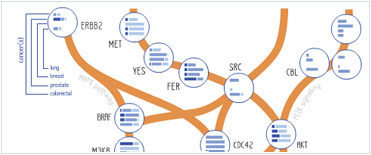







 Foundational characteristics of cancer include proliferation, angiogenesis, migration, evasion of apoptosis, and cellular immortality. Find key markers for these cellular processes and antibodies to detect them.
 The SUMOplot™ Analysis Program predicts and scores sumoylation sites in your protein. SUMOylation is a post-translational modification involved in various cellular processes, such as nuclear-cytosolic transport, transcriptional regulation, apoptosis, protein stability, response to stress, and progression through the cell cycle.
 The Autophagy Receptor Motif Plotter predicts and scores autophagy receptor binding sites in your protein. Identifying proteins connected to this pathway is critical to understanding the role of autophagy in physiological as well as pathological processes such as development, differentiation, neurodegenerative diseases, stress, infection, and cancer.
EphB2 Antibody (C-term) Blocking Peptide
Synthetic peptide
- SPECIFICATION
- CITATIONS
- PROTOCOLS
- BACKGROUND
| Primary Accession | P29323 |
|---|---|
| Clone Names | 2063010 |
| Gene ID | 2048 |
|---|---|
| Other Names | Ephrin type-B receptor 2, Developmentally-regulated Eph-related tyrosine kinase, ELK-related tyrosine kinase, EPH tyrosine kinase 3, EPH-like kinase 5, EK5, hEK5, Renal carcinoma antigen NY-REN-47, Tyrosine-protein kinase TYRO5, Tyrosine-protein kinase receptor EPH-3, EPHB2, DRT, EPHT3, EPTH3, ERK, HEK5, TYRO5 |
| Target/Specificity | The synthetic peptide sequence is selected from aa 1036~1051 of human EphB2. |
| Format | Peptides are lyophilized in a solid powder format. Peptides can be reconstituted in solution using the appropriate buffer as needed. |
| Storage | Maintain refrigerated at 2-8°C for up to 6 months. For long term storage store at -20°C. |
| Precautions | This product is for research use only. Not for use in diagnostic or therapeutic procedures. |
| Name | EPHB2 |
|---|---|
| Synonyms | DRT, EPHT3, EPTH3, ERK, HEK5, TYRO5 |
| Function | Receptor tyrosine kinase which binds promiscuously transmembrane ephrin-B family ligands residing on adjacent cells, leading to contact-dependent bidirectional signaling into neighboring cells. The signaling pathway downstream of the receptor is referred to as forward signaling while the signaling pathway downstream of the ephrin ligand is referred to as reverse signaling. Functions in axon guidance during development. Involved in the guidance of commissural axons, that form a major interhemispheric connection between the 2 temporal lobes of the cerebral cortex. Also involved in guidance of contralateral inner ear efferent growth cones at the midline and of retinal ganglion cell axons to the optic disk. In addition to axon guidance, also regulates dendritic spines development and maturation and stimulates the formation of excitatory synapses. Upon activation by EFNB1, abolishes the ARHGEF15-mediated negative regulation on excitatory synapse formation. Controls other aspects of development including angiogenesis, palate development and in inner ear development through regulation of endolymph production. Forward and reverse signaling through the EFNB2/EPHB2 complex regulate movement and adhesion of cells that tubularize the urethra and septate the cloaca. May function as a tumor suppressor. May be involved in the regulation of platelet activation and blood coagulation (PubMed:30213874). |
| Cellular Location | Cell membrane; Single-pass type I membrane protein. Cell projection, axon. Cell projection, dendrite |
| Tissue Location | Brain, heart, lung, kidney, placenta, pancreas, liver and skeletal muscle. Preferentially expressed in fetal brain |

Thousands of laboratories across the world have published research that depended on the performance of antibodies from Abcepta to advance their research. Check out links to articles that cite our products in major peer-reviewed journals, organized by research category.
info@abcepta.com, and receive a free "I Love Antibodies" mug.

Provided below are standard protocols that you may find useful for product applications.
Background
Ephrin receptors and their ligands, the ephrins, mediate numerous developmental processes, particularly in the nervous system. Based on their structures and sequence relationships, ephrins are divided into the ephrin-A (EFNA) class, which are anchored to the membrane by a glycosylphosphatidylinositol linkage, and the ephrin-B (EFNB) class, which are transmembrane proteins. The Eph family of receptors are divided into 2 groups based on the similarity of their extracellular domain sequences and their affinities for binding ephrin-A and ephrin-B ligands. Ephrin receptors make up the largest subgroup of the receptor tyrosine kinase (RTK) family. The ligand-activated form of EphB2, which belongs to the Tyr family of protein kinases, interacts with multiple proteins, including GTPase-activating protein (RASGAP) through its SH2 domain. It binds RASGAP through the juxtamembrane tyrosines residues, and also interacts with PRKCABP and GRIP1 This type I membrane protein is expressed in brain, heart, lung, kidney, placenta, pancreas, liver and skeletal muscle. It is preferentially expressed in fetal brain. This protein contains putatively 2 fibronectin type III domains and 1 sterile alpha motif (SAM) domain.
References
Thanos, C.D., et al., Science 283(5403):833-836 (1999).Tang, X.X., et al., Oncogene 17(4):521-526 (1998).Fox, G.M., et al., Oncogene 10(5):897-905 (1995).Ikegaki, N., et al., Hum. Mol. Genet. 4(11):2033-2045 (1995).Iwase, T., et al., Biochem. Biophys. Res. Commun. 194(2):698-705 (1993).

If you have used an Abcepta product and would like to share how it has performed, please click on the "Submit Review" button and provide the requested information. Our staff will examine and post your review and contact you if needed.
If you have any additional inquiries please email technical services at tech@abcepta.com.

Ordering Information
Other Products
Shipping Information
