






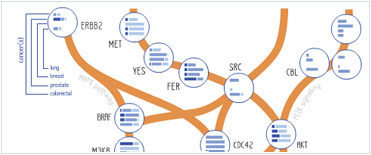








 Foundational characteristics of cancer include proliferation, angiogenesis, migration, evasion of apoptosis, and cellular immortality. Find key markers for these cellular processes and antibodies to detect them.
 The SUMOplot™ Analysis Program predicts and scores sumoylation sites in your protein. SUMOylation is a post-translational modification involved in various cellular processes, such as nuclear-cytosolic transport, transcriptional regulation, apoptosis, protein stability, response to stress, and progression through the cell cycle.
 The Autophagy Receptor Motif Plotter predicts and scores autophagy receptor binding sites in your protein. Identifying proteins connected to this pathway is critical to understanding the role of autophagy in physiological as well as pathological processes such as development, differentiation, neurodegenerative diseases, stress, infection, and cancer.
AMFR Antibody (C-term)
Purified Rabbit Polyclonal Antibody (Pab)
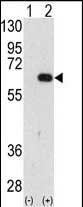
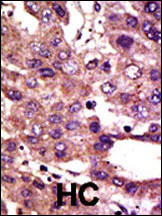

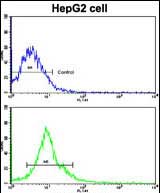
- SPECIFICATION
- CITATIONS: 2
- PROTOCOLS
- BACKGROUND

Application 
| IHC-P, FC, WB, E |
|---|---|
| Primary Accession | Q9UKV5 |
| Other Accession | P26442 |
| Reactivity | Human |
| Host | Rabbit |
| Clonality | Polyclonal |
| Isotype | Rabbit IgG |
| Calculated MW | 72996 Da |
| Antigen Region | 571-601 aa |
| Gene ID | 267 |
|---|---|
| Other Names | E3 ubiquitin-protein ligase AMFR, 632-, Autocrine motility factor receptor, AMF receptor, RING finger protein 45, gp78, AMFR, RNF45 |
| Target/Specificity | This AMFR antibody is generated from rabbits immunized with a KLH conjugated synthetic peptide between 571-601 amino acids of human AMFR. |
| Dilution | WB~~1:1000 IHC-P~~1:50~100 FC~~1:10~50 |
| Format | Purified polyclonal antibody supplied in PBS with 0.09% (W/V) sodium azide. This antibody is prepared by Saturated Ammonium Sulfate (SAS) precipitation followed by dialysis against PBS. |
| Storage | Maintain refrigerated at 2-8°C for up to 2 weeks. For long term storage store at -20°C in small aliquots to prevent freeze-thaw cycles. |
| Precautions | AMFR Antibody (C-term) is for research use only and not for use in diagnostic or therapeutic procedures. |
| Name | AMFR {ECO:0000303|PubMed:10456327, ECO:0000312|HGNC:HGNC:463} |
|---|---|
| Function | E3 ubiquitin-protein ligase that mediates the polyubiquitination of lysine and cysteine residues on target proteins, such as CD3D, CYP3A4, CFTR, INSIG1, SOAT2/ACAT2 and APOB for proteasomal degradation (PubMed:10456327, PubMed:11724934, PubMed:12670940, PubMed:19103148, PubMed:24424410, PubMed:28604676). Component of a VCP/p97-AMFR/gp78 complex that participates in the final step of endoplasmic reticulum-associated degradation (ERAD) (PubMed:10456327, PubMed:11724934, PubMed:19103148, PubMed:24424410). The VCP/p97-AMFR/gp78 complex is involved in the sterol-accelerated ERAD degradation of HMGCR through binding to the HMGCR-INSIG1 complex at the ER membrane (PubMed:16168377, PubMed:22143767). In addition, interaction of AMFR with AUP1 facilitates interaction of AMFR with ubiquitin-conjugating enzyme UBE2G2 and ubiquitin ligase RNF139, leading to sterol-induced HMGCR ubiquitination (PubMed:23223569). The ubiquitinated HMGCR is then released from the ER into the cytosol for subsequent destruction (PubMed:16168377, PubMed:22143767, PubMed:23223569). In addition to ubiquitination on lysine residues, catalyzes ubiquitination on cysteine residues: together with INSIG1, mediates polyubiquitination of SOAT2/ACAT2 at 'Cys-277', leading to its degradation when the lipid levels are low (PubMed:28604676). Catalyzes ubiquitination and subsequent degradation of INSIG1 when cells are depleted of sterols (PubMed:17043353). Mediates polyubiquitination of INSIG2 at 'Cys-215' in some tissues, leading to its degradation (PubMed:31953408). Also regulates ERAD through the ubiquitination of UBL4A a component of the BAG6/BAT3 complex (PubMed:21636303). Also acts as a scaffold protein to assemble a complex that couples ubiquitination, retranslocation and deglycosylation (PubMed:21636303). Mediates tumor invasion and metastasis as a receptor for the GPI/autocrine motility factor (PubMed:10456327). In association with LMBR1L and UBAC2, negatively regulates the canonical Wnt signaling pathway in the lymphocytes by promoting the ubiquitin-mediated degradation of CTNNB1 and Wnt receptors FZD6 and LRP6 (PubMed:31073040). Regulates NF-kappa-B and MAPK signaling pathways by mediating 'Lys-27'-linked polyubiquitination of TAB3 and promoting subsequent TAK1/MAP3K7 activation (PubMed:36593296). Required for proper lipid homeostasis (PubMed:37119330). |
| Cellular Location | Endoplasmic reticulum membrane; Multi-pass membrane protein. Note=Palmitoylation promotes localization to the peripheral endoplasmic reticulum |
| Tissue Location | Widely expressed.. |

Provided below are standard protocols that you may find useful for product applications.
Background
Autocrine motility factor (AMF) is a protein secreted by tumor cells that stimulates tumor motility. The gene for AMFR encodes a 323-amino acid polypeptide that has a single transmembrane domain and several putative glycosylation sites. The protein sequence has some homology to human tumor protein p53.
References
Huang, B., et al., Biochem. Biophys. Res. Commun. 212(3):727-742 (1995).
Watanabe, H., et al., J. Biol. Chem. 266(20):13442-13448 (1991).

If you have used an Abcepta product and would like to share how it has performed, please click on the "Submit Review" button and provide the requested information. Our staff will examine and post your review and contact you if needed.
If you have any additional inquiries please email technical services at tech@abcepta.com.


Ordering Information
Other Products
Shipping Information
