






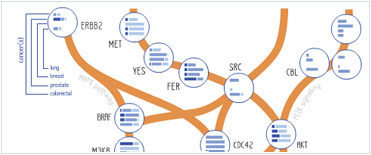








 Foundational characteristics of cancer include proliferation, angiogenesis, migration, evasion of apoptosis, and cellular immortality. Find key markers for these cellular processes and antibodies to detect them.
 The SUMOplot™ Analysis Program predicts and scores sumoylation sites in your protein. SUMOylation is a post-translational modification involved in various cellular processes, such as nuclear-cytosolic transport, transcriptional regulation, apoptosis, protein stability, response to stress, and progression through the cell cycle.
 The Autophagy Receptor Motif Plotter predicts and scores autophagy receptor binding sites in your protein. Identifying proteins connected to this pathway is critical to understanding the role of autophagy in physiological as well as pathological processes such as development, differentiation, neurodegenerative diseases, stress, infection, and cancer.
ACE Antibody (C-term) Blocking Peptide
Synthetic peptide
- SPECIFICATION
- CITATIONS
- PROTOCOLS
- BACKGROUND
| Primary Accession | P12821 |
|---|---|
| Clone Names | 80305106 |
| Gene ID | 1636 |
|---|---|
| Other Names | Angiotensin-converting enzyme, ACE, 321-, Dipeptidyl carboxypeptidase I, Kininase II, CD143, Angiotensin-converting enzyme, soluble form, ACE, DCP, DCP1 |
| Target/Specificity | The synthetic peptide sequence used to generate the antibody AP7793b was selected from the C-term region of human ACE. A 10 to 100 fold molar excess to antibody is recommended. Precise conditions should be optimized for a particular assay. |
| Format | Peptides are lyophilized in a solid powder format. Peptides can be reconstituted in solution using the appropriate buffer as needed. |
| Storage | Maintain refrigerated at 2-8°C for up to 6 months. For long term storage store at -20°C. |
| Precautions | This product is for research use only. Not for use in diagnostic or therapeutic procedures. |
| Name | ACE {ECO:0000303|PubMed:2849100, ECO:0000312|HGNC:HGNC:2707} |
|---|---|
| Function | Dipeptidyl carboxypeptidase that removes dipeptides from the C-terminus of a variety of circulating hormones, such as angiotensin I, bradykinin or enkephalins, thereby playing a key role in the regulation of blood pressure, electrolyte homeostasis or synaptic plasticity (PubMed:2558109, PubMed:4322742, PubMed:7683654, PubMed:7523412, PubMed:15615692, PubMed:20826823). Composed of two similar catalytic domains, each possessing a functional active site, with different selectivity for substrates (PubMed:1851160, PubMed:1320019, PubMed:7683654, PubMed:7876104, PubMed:10913258, PubMed:19773553). Plays a major role in the angiotensin-renin system that regulates blood pressure and sodium retention by the kidney by converting angiotensin I to angiotensin II, resulting in an increase of the vasoconstrictor activity of angiotensin (PubMed:4322742, PubMed:1851160, PubMed:11432860, PubMed:19773553, PubMed:23056909). Also able to inactivate bradykinin, a potent vasodilator, and therefore enhance the blood pressure response (PubMed:2558109, PubMed:6055465, PubMed:4322742, PubMed:6270633, PubMed:7683654, PubMed:15615692). Acts as a regulator of synaptic transmission by mediating cleavage of neuropeptide hormones, such as substance P, neurotensin or enkephalins (PubMed:656131, PubMed:6270633, PubMed:6208535, PubMed:15615692). Catalyzes degradation of different enkephalin neuropeptides (Met- enkephalin, Leu-enkephalin, Met-enkephalin-Arg-Phe and possibly Met- enkephalin-Arg-Gly-Leu) (PubMed:656131, PubMed:6270633, PubMed:2982830). Acts as a regulator of synaptic plasticity in the nucleus accumbens of the brain by mediating cleavage of Met-enkephalin- Arg-Phe, a strong ligand of Mu-type opioid receptor OPRM1, into Met- enkephalin (By similarity). Met-enkephalin-Arg-Phe cleavage by ACE decreases activation of OPRM1, leading to long-term synaptic potentiation of glutamate release (By similarity). Also acts as a regulator of hematopoietic stem cell differentiation by mediating degradation of hemoregulatory peptide N-acetyl-SDKP (AcSDKP) (PubMed:8257427, PubMed:7876104, PubMed:8609242, PubMed:26403559). Acts as a regulator of cannabinoid signaling pathway by mediating degradation of hemopressin, an antagonist peptide of the cannabinoid receptor CNR1 (PubMed:18077343). Involved in amyloid-beta metabolism by catalyzing degradation of Amyloid-beta protein 40 and Amyloid-beta protein 42 peptides, thereby preventing plaque formation (PubMed:11604391, PubMed:16154999, PubMed:19773553). Catalyzes cleavage of cholecystokinin (maturation of Cholecystokinin-8 and Cholecystokinin-5) and Gonadoliberin-1 (both maturation and degradation) hormones (PubMed:2983326, PubMed:7683654, PubMed:9371719, PubMed:10336644). Degradation of hemoregulatory peptide N-acetyl-SDKP (AcSDKP) and amyloid-beta proteins is mediated by the N-terminal catalytic domain, while angiotensin I and cholecystokinin cleavage is mediated by the C-terminal catalytic region (PubMed:7876104, PubMed:10336644, PubMed:19773553). |
| Cellular Location | Cell membrane; Single-pass type I membrane protein. Cytoplasm {ECO:0000250|UniProtKB:P09470}. Note=Detected in both cell membrane and cytoplasm in neurons. {ECO:0000250|UniProtKB:P09470} [Isoform Testis-specific]: Cell membrane; Single-pass type I membrane protein. Secreted. Note=The testis-specific isoform can be cleaved before the transmembrane region, releasing a soluble form |
| Tissue Location | Ubiquitously expressed, with highest levels in lung, kidney, heart, gastrointestinal system and prostate |

Thousands of laboratories across the world have published research that depended on the performance of antibodies from Abcepta to advance their research. Check out links to articles that cite our products in major peer-reviewed journals, organized by research category.
info@abcepta.com, and receive a free "I Love Antibodies" mug.

Provided below are standard protocols that you may find useful for product applications.
Background
ACE is an enzyme involved in catalyzing the conversion of angiotensin I into a physiologically active peptide angiotensin II. Angiotensin II is a potent vasopressor and aldosterone-stimulating peptide that controls blood pressure and fluid-electrolyte balance. This enzyme plays a key role in the renin-angiotensin system. Many studies have associated the presence or absence of a 287 bp Alu repeat element in this gene with the levels of circulating enzyme or cardiovascular pathophysiologies. Two most abundant alternatively spliced variants of this gene encode two isozymes - the somatic form and the testicular form that are equally active.
References
du Cheyron,D.,Crit. Care Med. 36 (12), 3178-3183 (2008)Pang,S., Biochem. J. 358 (PT 1), 185-192 (2001)Woodman,Z.L., Biochem. J. 347 PT 3, 711-718 (2000)

If you have used an Abcepta product and would like to share how it has performed, please click on the "Submit Review" button and provide the requested information. Our staff will examine and post your review and contact you if needed.
If you have any additional inquiries please email technical services at tech@abcepta.com.

Ordering Information
Other Products
Shipping Information
